


Outdoor time is learning time. When children jump, count, chase and take turns outside, they're building the same skills educators plan for indoors, with a lot more energy.
Australia's 24-Hour Movement Guidelines recommend that preschoolers (3–5 years) get at least 180 minutes of physical activity a day, including 60 minutes of energetic play. The right outdoor surface makes that easier to deliver, and easier to link back to your learning program.
In this guide, we cover what the Early Years Learning Framework (EYLF) says about outdoor environments, then share 9 simple turf games your educators can run tomorrow, what each one teaches, and how to plan for heat and safety.
In this article
What the EYLF says about outdoor learning
The EYLF (V2.0) is Australia's national framework for early childhood education. It describes quality learning environments as indoor and outdoor spaces that "invite all children to participate at a level they are comfortable in", while adding enough challenge to stretch their learning.
It connects closely to National Quality Standard (NQS) Quality Area 3: Physical environment, which looks at how your spaces are designed and organised to support play-based learning.
The EYLF is built around five learning outcomes:
A well-planned outdoor play space can support every one of these. Simple, familiar games are one of the easiest ways to do it.

9 turf games and what they teach
Each of these is based on one of Aloro's ready-made activity grass designs. The game ideas work just as well with chalk or markers. A permanent surface simply means they're always there, ready to play.
LEARN

1. Alphabet Turf
- Letter hunt: call a letter and children race to stand on it.
- Name spell: children hop from letter to letter to spell their own name.
- Sound match: "Find the letter that starts sun."
Builds: letter recognition, early phonics, listening

2. Rocketship with Numbers
- Countdown launch: start at 10, hop down to 1, then "blast off" with a big jump.
- Number freeze: educator calls a number, children freeze on it.
- Space stories: where is the rocket going? Who is on board?
Builds: counting forwards and backwards, imagination, gross motor skills

3. Snake with Numbers
- Slither and count: move along the snake, counting each step aloud.
- Odds and evens: only step on even numbers on the way back.
- Dice walk: roll a large foam dice and move that many spaces.
Builds: number sequencing, balance, early maths concepts
PLAY
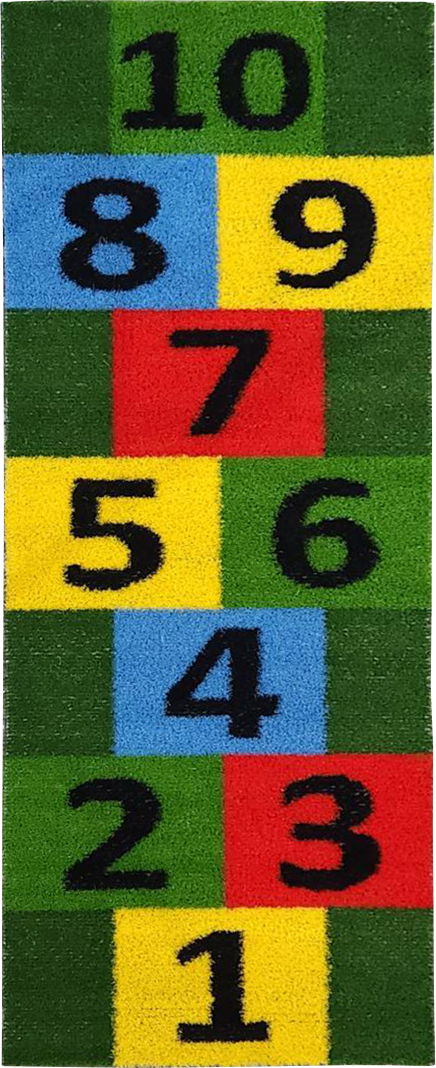
4. Hopscotch
- Classic hopscotch: toss a beanbag, hop over that square.
- Animal hops: frog jumps, bunny hops, kangaroo bounds.
- Younger children: two-foot jumps only, counting each square.
Builds: balance, coordination, taking turns, counting

5. Snakes & Ladders
- Life-size board game: children are the playing pieces.
- Team play: pairs move together and make decisions as a group.
- Feelings check: talk about how it feels to slide down a snake, and how to bounce back.
Builds: following rules, patience, resilience, social skills
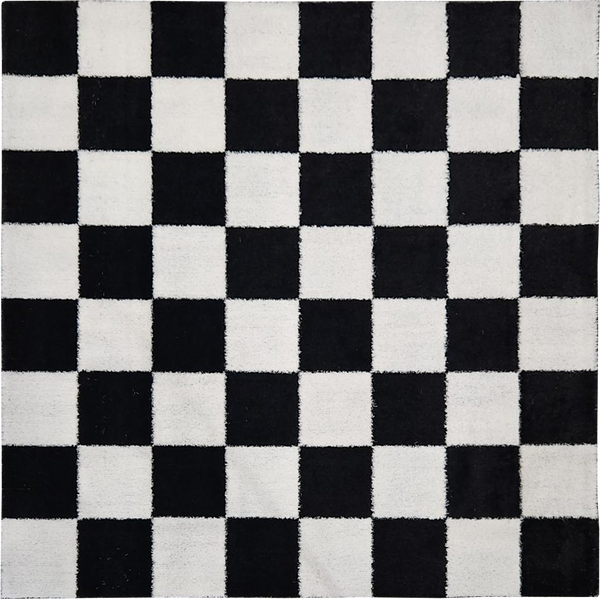
6. Chess Board
- Black and white: "Everyone on a white square!" Great for younger children.
- Pattern walk: step black, white, black, white across the board.
- Older children: giant chess or draughts with large pieces.
Builds: patterns, colour and shape recognition, strategic thinking
MOVE
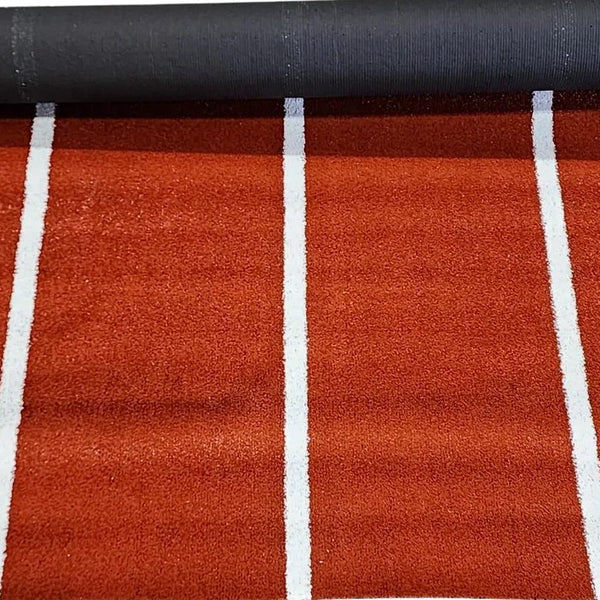
7. 4 Lane Running Track
- Lane races: run, skip, gallop or crab-walk in your lane.
- Relay: pass a beanbag to the next runner.
- Mini sports day: a ready-made track for end-of-year events.
Builds: energetic play, coordination, teamwork
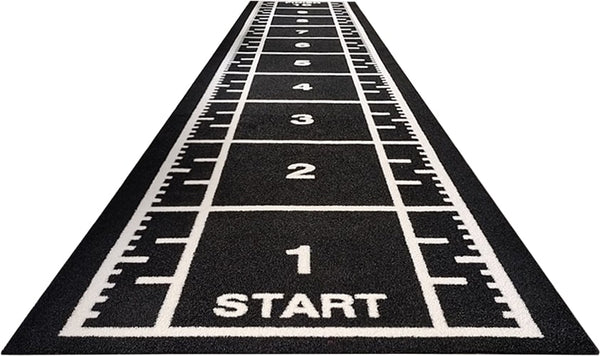
8. Track with Numbers
- How far can you jump? Children see their distance as a number.
- Number sprint: run to the number the educator calls.
- Beat your best: track progress over the term.
Builds: measurement, number recognition, confidence
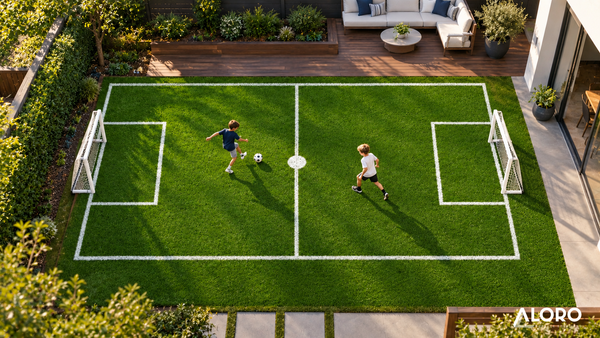
9. Mini Soccer Field
- Dribble and stop: move the ball, freeze on the whistle.
- Goal kicks: take turns and cheer each other on.
- Small-sided games: 2v2 or 3v3 keeps everyone involved.
Builds: ball skills, cooperation, energetic play
See all 9 designs in our Activity Grass range
Browse Activity Grass →Quick reference: games mapped to EYLF outcomes
Use this table when planning, programming or documenting outdoor learning. Most games touch several outcomes. We've listed the ones each game links to most closely.
| Game | Key skills | EYLF outcomes |
|---|---|---|
| Alphabet Turf | Letter recognition, phonics | 4, 5 |
| Rocketship with Numbers | Counting, imagination | 3, 4, 5 |
| Snake with Numbers | Number sequencing, balance | 3, 4 |
| Hopscotch | Balance, turn-taking | 2, 3, 4 |
| Snakes & Ladders | Rules, resilience, social skills | 1, 2, 3 |
| Chess Board | Patterns, strategy | 4 |
| 4 Lane Running Track | Energetic play, teamwork | 2, 3 |
| Track with Numbers | Measurement, confidence | 1, 3, 4 |
| Mini Soccer Field | Ball skills, cooperation | 2, 3 |
Making it culturally meaningful

EYLF V2.0 encourages educators to create opportunities for children to "learn on Country" and to build connections with Aboriginal and Torres Strait Islander cultures and places.
A custom First Nations-themed play surface can be a lasting part of that. The most meaningful designs are created in collaboration with local Elders, community members or Aboriginal and Torres Strait Islander artists, so the artwork reflects the Country your service is on.
Planning a custom design? Aloro can create custom activity grass, including First Nations-themed artwork, school logos and mascots. Talk to our team.
Planning for heat and safety
Heat: shade comes first
Like most artificial surfaces, synthetic grass can get very hot in direct summer sun. Research by Western Sydney University measured artificial turf in full sun at nearly 100°C on days in the low 30s, and found shade made a big difference.
For childcare services, that means:
- Install activity grass in shaded areas, under trees or shade sails.
- Check the surface before play on warm days, the same way you would for slides and softfall.
- Plan energetic outdoor play for cooler parts of the day in summer.
- A quick hose-down can help cool the surface before use.
Safety: ground-level play only
Activity grass is designed for ground-level games like hopscotch, running and ball play. Under any equipment children can fall from, such as climbing frames, swings and slides, your surface needs to be tested to AS 4422 with a critical fall height that meets or exceeds the equipment's fall height.
Not sure what that means for your service? Read our guide: AS 4422 Explained: What Your Childcare Playground Surfacing Actually Needs.
FAQs
What outdoor activities support the EYLF?
Almost any purposeful outdoor play can. Games that combine movement with counting, letters, rules or teamwork are especially useful, because they link to several EYLF outcomes at once: wellbeing, confident learning, communication and connection with others.
How much physical activity do preschoolers need?
Australia's 24-Hour Movement Guidelines recommend at least 180 minutes of physical activity a day for preschoolers (3–5 years), including at least 60 minutes of energetic play, spread throughout the day.
Does synthetic grass get hot in childcare playgrounds?
It can in direct summer sun. Install it in shade, check the surface before play on warm days, and plan energetic play for cooler times of the day.
Can activity grass go under play equipment?
Activity grass is designed for ground-level play. Under equipment with a fall height, you need a surfacing system tested to AS 4422. See our AS 4422 guide for details.
How do you clean activity grass?
Remove leaves and debris regularly with a leaf blower or rake, and rinse with water from time to time. For a deeper clean, use a mild detergent.
Can we get a custom design?
Yes. Aloro can create custom activity grass designs, including First Nations-themed artwork. Contact our team to talk about your idea.
Ready to bring learning outdoors?
Explore our ready-made Activity Grass designs, or talk to us about a custom design for your service.
Shop Activity Grass → Ask About Custom DesignsOr call us on 1300 052 398
Sources: ACECQA – EYLF Practices: Learning environments · Healthy WA – 24-Hour Movement Guidelines · Western Sydney University – Materials that make heat worse for our kids


